
In short. Why skin cancer excision puts complete clearance before a small scar: how margins are chosen and measured, what an involved margin means, and when margin-controlled excision is used.
Key points
- It is entirely reasonable to care about how the scar looks — and a good surgeon cares too.
- But the sequencing is not negotiable.
- Removing too little in order to keep a scar small trades a certainty of cure for a hope of a nicer line, and a recurrence that grows under a scar is harder to find and harder to treat than the original tumour.
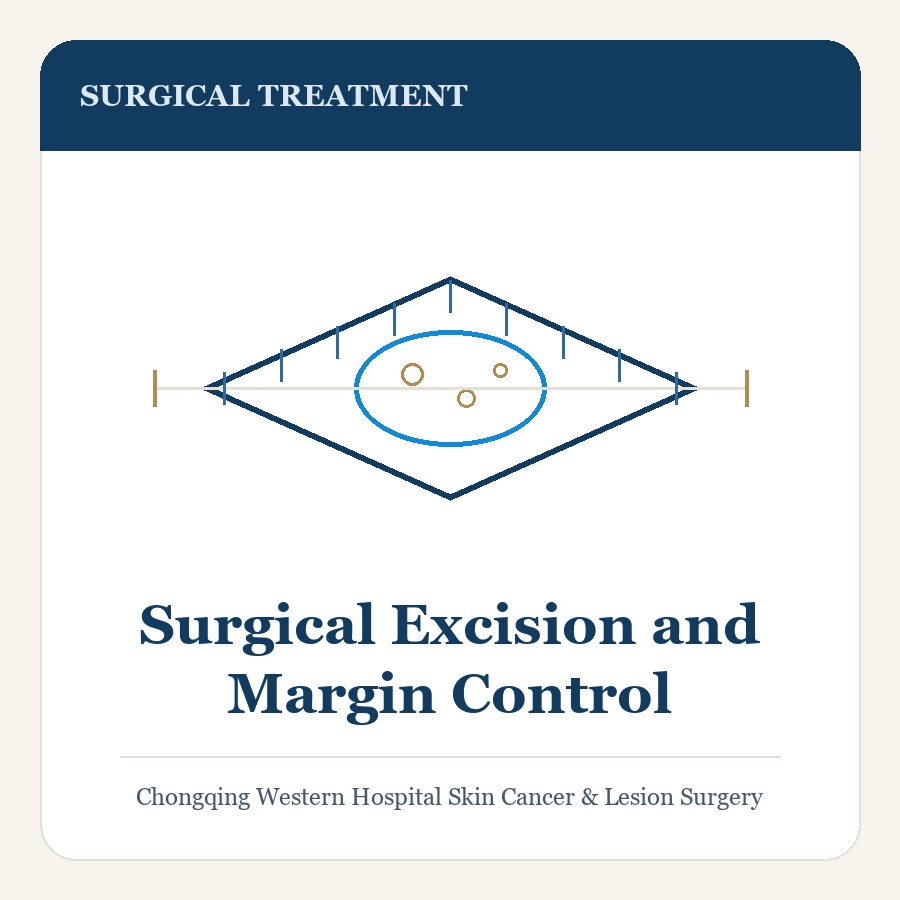
The operation that treats most skin cancer is not complicated, but it is unforgiving of shortcuts. The tumour is removed together with a measured rim of normal-looking skin, and the specimen is examined to confirm that the rim was free of tumour. The priority is deliberate: complete clearance comes before the size of the scar, because an incomplete excision means the cancer is still there.
Choosing the margin
The width of the rim is not guesswork. It follows the diagnosis and the risk of the tumour: a superficial basal cell carcinoma needs only a narrow margin, a morphoeic or high-risk squamous cell carcinoma needs considerably more, and a melanoma needs a margin set by its measured thickness. Site modifies the plan as well, because skin is scarce on the eyelid, nose and ear, and a wider margin there has consequences that must be weighed but not allowed to compromise clearance.
How margins are checked
The excised specimen is sent to pathology, where it is inked, sliced and examined under the microscope. The report states whether tumour reaches the inked edge. A margin reported as clear at a stated distance is evidence that the operation did what it set out to do. A margin reported as involved or close is information that changes the plan, usually into a further excision.
Clearance before appearance
It is entirely reasonable to care about how the scar looks — and a good surgeon cares too. But the sequencing is not negotiable. Removing too little in order to keep a scar small trades a certainty of cure for a hope of a nicer line, and a recurrence that grows under a scar is harder to find and harder to treat than the original tumour. A slightly larger repair, planned properly, is a much better bargain than a narrow excision that was not complete.
Standard excision and margin-controlled excision
Standard excision removes the tumour with a predetermined margin in one procedure, relying on the pathologist to check the specimen afterwards. Margin-controlled serial excision, in which the entire peripheral and deep margin is examined while the patient waits and further tissue is taken only where tumour is found, is reserved for tumours where conserving tissue matters most or the true extent is uncertain: morphoeic basal cell carcinoma, recurrent tumours, and lesions on the eyelid, nose, ear and lip. It takes longer, and gives the highest confidence that the tumour is gone.
What an involved margin means
An involved margin does not mean the cancer has spread; it means the operation did not remove all of it. The usual response is a further excision around the involved area, sometimes with a margin-controlled technique, and sometimes with imaging or radiotherapy if surgery is not feasible. This is a routine turn of events, not a failure of the first operation, and it is why follow-up and pathology matter as much as the surgery.
Seek review promptly if
- You are told that a margin was involved or close, and no plan for further treatment has been arranged.
- The wound bleeds persistently, opens up, or shows spreading redness, warmth or discharge.
- A new lump, thickening or ulceration appears in or around the excision scar.
Frequently asked questions
Why is a slightly larger excision preferred over a smaller scar?
Removing too little in order to keep a scar small trades a certainty of cure for a hope of a nicer line. A recurrence that grows under a scar is harder to find and harder to treat than the original tumour, while a slightly larger repair, planned properly, is a better bargain.
When is margin-controlled serial excision used instead of standard excision?
It is reserved for tumours where conserving tissue matters most or the true extent is uncertain: morphoeic basal cell carcinoma, recurrent tumours, and lesions on the eyelid, nose, ear and lip. The entire peripheral and deep margin is examined while the patient waits.
Does an involved margin mean the cancer has spread?
No. It means the operation did not remove all of it. The usual response is a further excision around the involved area, sometimes with a margin-controlled technique, and sometimes with imaging or radiotherapy if surgery is not feasible. This is a routine turn of events.
Risks & Limitations
- Incomplete excision, which may require a further operation to achieve clear margins.
- Recurrence of the skin cancer, and the need for surveillance for years afterwards.
- Scars are permanent. They mature and fade but never disappear.
- Problems with a graft or flap, including partial or complete loss, which may need further surgery.
- Numbness, altered sensation or nerve injury around the operated area.
- Melanoma carries a risk of spread that surgery cannot remove, even when the excision is complete.
- Pigment change, contour irregularity, or a scar that widens or thickens.
- Final assessment of the scar is made at 6–12 months, and surveillance continues longer.
When to Seek Care
- A lesion that changes in size, shape, colour or height, or that starts to bleed or itch.
- A new, rapidly growing nodule, or a sore that is not healing.
- A mole that becomes painful or bleeds.
- Swelling in a lymph node region — the neck, armpit or groin.
- A graft or flap that turns dark, cold or black, or a wound that opens or discharges.
- Fever above 38 °C, or spreading redness, warmth or pain around a wound.
References & Further Reading
- American Academy of Dermatology (AAD) — skin cancer diagnosis and treatment guidance
- American Cancer Society (ACS) — skin cancer types, staging and outlook
- Skin Cancer Foundation — prevention and skin self-examination resources
- American Society of Plastic Surgeons (ASPS) — reconstruction after skin cancer excision
- Cochrane Library — systematic reviews in skin cancer treatment and prevention
- Chinese Medical Association — clinical guidance for skin tumours and dermatologic surgery
This page is patient education, not medical advice, and it does not cite individual studies. Discuss your own case with a qualified clinician. To arrange an assessment at Chongqing West District Hospital, see Contact & Consultation.